
Would you still be a leader?
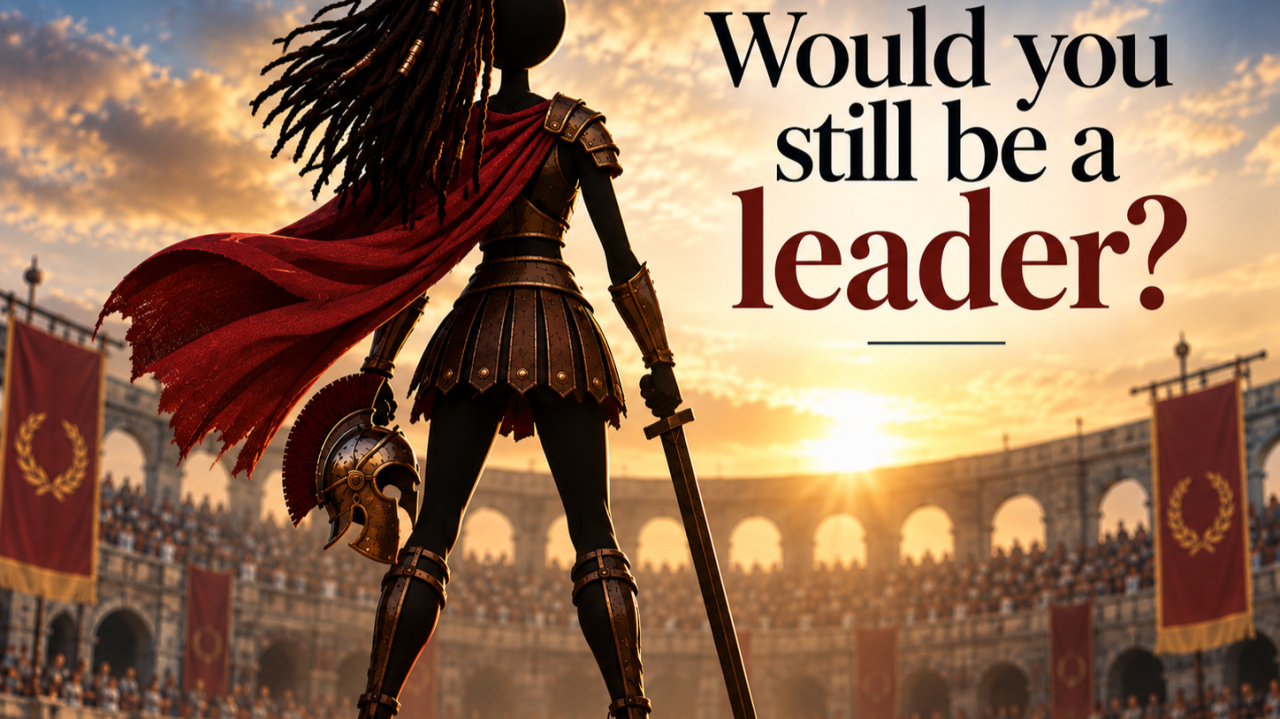
Gladiator is one of those movies I can return to and see something different each time. This time, I was not watching Maximus the warrior. I was watching Maximus the leader — and one question would not leave me alone: if they took away your title tomorrow, how much of your leadership would remain?
Gladiator is one of those movies I can return to and see something different each time. I have always enjoyed the story, the intensity and, of course, Maximus. But perhaps where we are in our own lives influences what we see when we revisit something familiar. This time, I was not watching Maximus the warrior. I was watching Maximus the leader, and more importantly, I found myself thinking about what his journey says about personal leadership.
It made me think about this — if they took away your title tomorrow, how much of your leadership would remain?
The more I thought about it, the more I realized that the question goes much deeper than a job title. What happens when the things we have used to define ourselves change? What happens when the position disappears, the applause goes away, the people who once needed us no longer do, or life moves us into a space where our previous accomplishments carry considerably less weight? Who are we then?
I have come to believe that personal leadership begins somewhere around that question. It is relatively easy to feel like a leader when the environment reinforces that identity and the title confirms it. When the organization recognizes it, people seek our opinion and important decisions require our approval. During these periods, our calendar is full and our presence seems important, but those things can also become evidence we use to convince ourselves that we are invincible. Do not get me wrong, all the aforementioned matter — but what if we lose them? What then?
When the markers disappear
That is where Gladiator became much more interesting to me. Maximus loses almost every external marker of who he was. He goes from commanding armies to having virtually no control over his own circumstances. His title disappears, his authority disappears, his status disappears and even his freedom disappears. Yet his capacity to influence people remains.
That made me think about how much of leadership is actually internal. If leadership exists only when people recognize our authority, perhaps what we have developed is position rather than leadership. If our confidence disappears when the title disappears, perhaps some of our confidence was borrowed from the title. If we can only influence people who are required to listen to us, perhaps we need to reconsider what influence really means. Yes? No?
I find myself asking these questions of my own leadership. Over the years, I have occupied different spaces, carried different titles, and experienced different versions of myself as a follower and as a leader. With time, I have become less interested in whether a title tells people I am a leader and more interested in what people experience when I show up. Do I create clarity or confusion? Do people feel they can think around me, or do they simply wait for me to think for them? Can someone disagree with me without worrying about what it will cost them? Am I building capable people, or am I unconsciously building dependence on me?
Those questions are harder than asking whether we are effective leaders because they require us to examine not simply what we accomplish, but what happens to other people in our presence. The contrast between Maximus and Commodus makes this especially powerful. Commodus has enormous formal power. He has the title, the throne, and the machinery of the empire behind him, yet he constantly seeks something his position cannot automatically provide — respect, loyalty, and validation. Maximus repeatedly attracts those things even after formal authority has been taken away.
What power can hide
Power can sometimes hide weaknesses in our leadership. When people have to comply, we may never discover whether they would have chosen to cooperate. When people are reluctant to challenge us, we may mistake silence for agreement. When everyone around us tells us we are doing well, we may never know whether we have created respect or simply created an environment where honesty feels risky.
Perhaps one of the hardest personal leadership lessons is learning not to need the people we lead to constantly reassure us that we are worthy of leading them. Leadership cannot become an emotional support system for the leader. That thought stays with me because insecurity does not necessarily disappear as responsibility increases. Sometimes responsibility simply gives insecurity more places to hide. It can hide behind control, behind perfectionism, behind an unwillingness to delegate. It can even hide behind the belief that because we are accountable, we must always be right. Can you relate?
Personal leadership requires enough self-awareness to recognize when our need to control an outcome is really our discomfort with trusting someone else.
Stronger together
In the arena, the gladiators begin as individuals trying to survive. Maximus understands that individual strength will not be enough and that their best chance comes when they stop operating only for themselves and begin operating together. There is something deeply personal in that lesson. Leadership is not proving that I can do everything myself. In fact, the longer I lead, the more I question that version of strength. There are moments when leadership means stepping forward, but there are equally important moments when leadership means creating enough room for someone else to step forward. Sometimes the strongest thing a leader can say is, "I don't know." Sometimes it is, "What do you think?" Sometimes it is simply recognizing that the collective intelligence around us may be greater than our own. That requires a different kind of confidence and a genuine intent to create capacity.
Maximus continues moving even when almost everything familiar has been taken from him. That is purpose-driven! Whatever we think about the choices he makes, there is something worth examining in the ability to remain connected to purpose when circumstances change.
That may be one of the most important dimensions of personal leadership. Can I remain grounded when things do not go according to plan? Can I change direction without interpreting the change as failure? Can I lose something I worked hard for without losing myself with it? Can I enter a season where I am no longer the person at the centre and still recognize my value?
Those questions (even if difficult to articulate or embrace) become increasingly important as our careers and lives evolve, because leadership, eventually, asks us to confront impermanence.
Things change — positions, organizations, relationships, priorities. The things we once pursued intensely may no longer matter quite as much, but if our entire sense of identity has been constructed around what we do, change can feel like disappearance.
Perhaps then, mature personal leadership is learning to distinguish between what we do, what we have and who we are.
Legacy is immediate
There is also a more subtle lesson in Gladiator, about legacy. We often talk about legacy as though it is something grand that people discuss after we are gone. I increasingly think legacy is much more immediate than that. We are creating it in the way people learn to think around us, in whether they become more confident or less confident because of our leadership, in whether we leave people more capable than we found them. That makes a material difference and changes the question from "Will people remember me?" to something I find much more meaningful: "What will people be able to do because I was here?"
Perhaps that is what personal leadership ultimately asks of us. Not whether we can hold power, but whether we can remain grounded when we have it. Not whether people follow us, but whether they become stronger while walking with us. Not whether we always know the answer, but whether we have enough confidence to keep asking better questions. Not whether our title announces our importance, but whether our character continues to speak when the title no longer does.
Gladiator has always been about the battles, the sound effects, the passion, the drama — and while I still see all of this, I also see a leadership question that reaches far beyond the movie.
If everything that publicly identified you as a leader disappeared tomorrow, what would be left?
I had to ask myself: would that be a résumé, a list of accomplishments, or the titles I have accumulated along the way? I definitely do not want that. What I hope would remain is the ability to think, to listen, to influence without controlling, to help others become stronger, to adapt without losing myself and to continue finding purpose when circumstances change. Because perhaps position can give us power over people, but leadership creates influence with people. The title tells people where we sit — but our personal leadership tells them who we are when there is no special seat reserved for us. And that may be the leadership worth working on most.
Question for you: If the title, recognition, and authority disappeared tomorrow, what would your leadership still have to offer?